Who The F**k Are You?
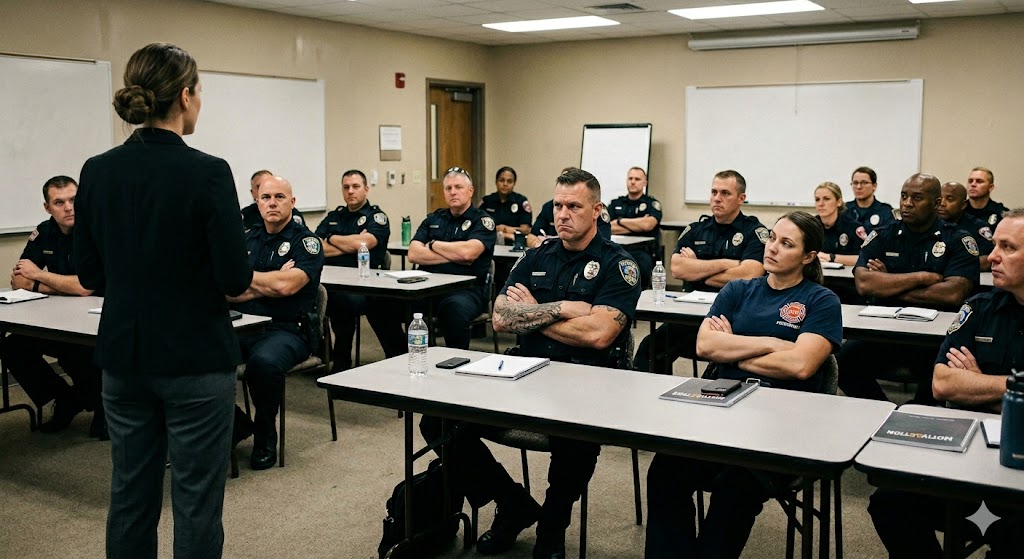
We walked into our first responder training room, and we could feel it.
The looks. The crossed arms. The body language that said exactly what they were thinking.
Who the f**k are you?
You're not one of us. You don't know what we're going through. And you sure as hell don't know what it's like to do this job.
They didn't say it out loud. But we heard it anyway.
And here's the thing: they were right
We're Not In Their World
We're not in their world, and we're not going to pretend that we are.
We won't claim to know what it's like to wear the uniform or face what first responders face daily. We haven't responded to the calls they respond to. We haven't seen what they've seen. We haven't carried what they carry.
But here's what we do know.
We've lived the reality of high-pressure careers, working alongside those in relentless, high-stakes environments. We've worked with individuals facing burnout, PTSD, depression, trauma, and the weight of cumulative stress. Including first responders.
We've not only seen but experienced how exhaustion and strained relationships build over time when there's no space to process or reset. And we know that resilience isn't just about pushing through. It's about training for mental strength the same way first responders train for everything else in their profession.
Here's Why It's Different
We don't teach first responders how to do their jobs.
They already have phenomenal training. Relentless training. They train tactics, defensive strategies, and emergency responses until they're second nature.
They don't need us to tell them how to respond to a call. They don't need us to teach them protocol. They don't need us to explain their job to them.
Here's the parallel: You don't need to be a police officer to know how to shoot a gun. You don't need to be an EMS professional to know how to use first aid kits.
And we don't need to be first responders to understand the weight of the work. The corrosion that destroys people's lives when it goes unaddressed.
What we teach is this:
How to regulate and communicate internally and externally. How to recognize stress before it takes control. How to reset your mindset before emotions drive decisions. How to leave work at work without needing to numb out to do it.
We give them tools to survive the job they already know how to do.
That's the difference.
We Say It Out Loud
One of the reasons our trainings are received so well is that we say out loud what first responders are thinking about us.
We don't hide behind who we're not.
We name the elephant in the room.
In our first sessions, we literally say:
"We're not in your world, and we're not going to pretend that we are. We know you're wondering who the f**k we are and why you should listen to us. So let's address that right now."
That breaks the ice. It reveals the elephant. And it shifts the dynamic from skepticism to curiosity.
Because the truth is, first responders train relentlessly to protect their communities. They drill tactics until they're second nature. But here's the question: How often do they train to protect their minds?
They know how to recognize a mental health crisis in the public. But how often do they see the signs in their own people? And when they do, how many actually acknowledge it, speak up, and feel confident knowing what to say?
That's why we created C.A.R.E.S. Not as outsiders trying to "fix" anything. But as professionals bringing proven tools to help those who serve every day.
The Numbers Don't Lie
Eighty-five percent of first responders report battling mental health symptoms.
PTSD and depression rates are five times higher than in civilians.
Suicide rates in law enforcement are higher than line-of-duty deaths.
Yet despite an increase in mental health resources, only 35 percent of first responders actually use them.
So it's not that the problem isn't recognized. It's that these challenges don't always have an outlet. And when stress, exhaustion, and emotional strain build up without a release, they don't just impact job performance. They start seeping into everything. Home life. Friendships. Even the way people view themselves.
It's not a lack of toughness. It's not about whether first responders can handle the job. They've already proven that.
It's that the traditional culture has emphasized endurance over awareness. Where asking for help is seen as a weakness. Where wellness training is often deprioritized, underutilized, underfunded, or simply ineffective.
But what happens when stress goes unaddressed? The slow erosion that follows?
The consequences can be severe. Divorce. Career burnout. Substance abuse. Depression. And in more and more cases, suicide.
By the time someone reaches that breaking point, they often feel helpless and hopeless. Like they have no other option. Especially in a culture where struggling is seen as weak, where it's not openly talked about, and where admitting you need help can fast track you to a desk job or even being fired.
Everyone Says We Need Change
Everyone says "we need change."
But nobody wants to change.
We saw this in the beginning. Everybody said how great our training was. But nobody wanted to pay for it.
We found a private donor who was willing to cover a significant portion of the cost. That didn't even move the needle.
The same thing happened with educational institutions.
Because trust has to be earned. And we get that.
How We Earned It
The 30-minute workshops.
That's what worked.
Short, FREE, extremely well-received sessions where first responders could see what we actually do. Not theory. Not fluff. The actual tools they could apply immediately.
They walked out saying,
"That was different."
"That actually made sense."
"I've never thought about it that way before."
Those small sessions built trust. One room at a time. One agency at a time.
And eventually, the people who were skeptical in the beginning became the ones advocating for us to come back.
What They Actually Walk Away With
So what do participants actually walk away with?
They learn how to recognize stress before it takes control. Reset their mindset before emotions drive decisions. And stay grounded so they don't take the job out on their families or carry it like a weight into every interaction.
They build communication skills that go beyond the tactical. To actually talk with people, not at them. That means deeper trust with their teams and better connection at home.
They stop bringing the whole shift home in their tone, their silence, or their distance. And start learning how to leave work at work, without needing to numb out to do it, so they can be present where it matters.
Possibly most important, they walk away with a better sense of who they are beyond the badge. So when the shift ends, or even when the career ends, they don't lose themselves with it.
This isn't about making them softer. It's about making them sharper, more connected, and more equipped to keep doing the job without breaking under it.
Why Outsider Perspective Is The Asset
Here's the thing about not being first responders: It's actually the asset, not the liability.
Because we're not embedded in the culture that says people have to white-knuckle it. We're not carrying the belief that asking for help is weak. We're not operating under the unspoken rule that struggling means you can't hack it.
We come in with a different lens. One that says: Mental fitness is just as critical as physical fitness. Emotional regulation is just as important as tactical training. And recognizing stress early is just as valuable as recognizing threats in the field.
First responders train before they need it for everything else. They don't wait until they're in a shootout to learn how to fire their weapon.
Mental resilience should be the same.
We're Not Pretending
So no, we're not first responders.
We're not going to stand here and claim we know what it's like to do their job.
But we do know what happens when high-pressure, high-stakes work goes unprocessed. We know what chronic stress does to relationships, decision-making, and long-term health. And we know the tools that actually work to manage it.
We're not here to teach first responders their jobs. We're here to give them the tools to survive them.
And we're not going to pretend to be something we're not.
Because the moment we do, we lose the only thing that matters: their trust.
At The Academy of MotivAction®, we work with law enforcement agencies, fire departments, EMS organizations, and first-responder training programs to integrate the C.A.R.E.S.™ Framework into both academy curriculum and ongoing professional development.
We're not first responders. But we know how to help the people who are.
If you're looking to support your personnel at every stage of their careers, let's talk.


