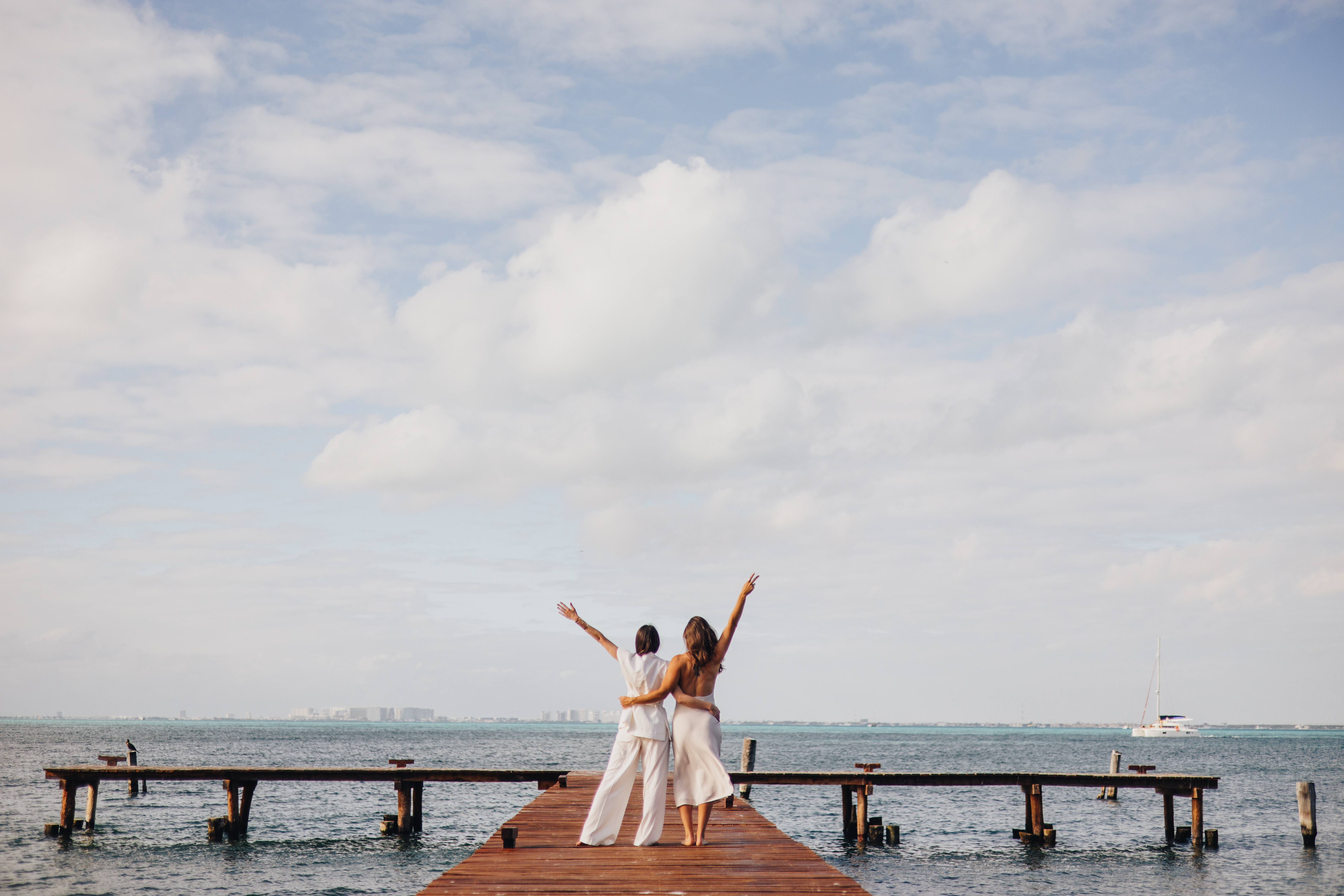
What It Actually Means to Celebrate Women
What does it actually mean to celebrate women when some of your deepest wounds came from them?
That’s not a rhetorical question. It’s the one I find myself sitting with every time International Women’s Day rolls around, and this year, I’m not going to sidestep it. Because if we’re going to talk about lifting women up, honoring women, being in community with women, we have to be willing to talk about what makes that hard. Not as an excuse to stay guarded. As a reason to do the work anyway.
This is my version of that work.
A few years back I experienced what felt like an intimate betrayal by a close friend.
I’m protecting anonymity here, not because what happened wasn’t real, but because she is more than that moment, and so is the point of this blog.
What made it particularly brutal was that we worked closely together, which meant that when it all came out, there was no clean exit. No cathartic goodbye. We had to keep showing up, side by side, every single day.
And the hardest part wasn’t the experience of the betrayal itself. It was that I’d been actively working through years of stories about women stabbing me in the back. And in my head, in that moment, the story was here is a close friend, confirming every single one of them.
That story and how she and I navigated it, deserves its own telling. And maybe someday it will get one. But what matters for this piece is what it left behind.
Not a decision. Not a philosophy about women. Something deeper than that. A wound that had been starting to heal, slowly and quietly, ripped back open. And what came with it was a nervous system that stayed on alert. Scanning. Watching for the next betrayal before it could land. My logic knew that’s not all women. My body didn’t care. The story it carried was louder than anything my brain could reason through.
In the years that followed, I didn’t retreat from women. If anything, I leaned harder into working with them. And looking back, I think that’s partly why.
I was running a women’s empowerment program, leading workshops, helping women find their voice and step into their power. I was also the executive director of a nonprofit where we taught women and girls self-defense, though really, it was always about empowerment.
Something in me understood, even before I could have articulated it, that the work wasn’t just for them. It was navigating something in my own system, a nervous system that wanted to keep scanning for danger while my logical brain was just trying to get back to baseline. Trying to close the gap between what I knew to be true about women and what my body still braced for every time I let one close.
I held both of those things at once for years: doing this work for women, while still quietly untangling my own complicated relationship with them. I didn’t think those two things were contradictory at the time. Looking back, I think they were just honest. You don’t have to have it all figured out to be useful. You just have to be a step or two ahead and willing to keep walking.
What I hadn’t yet found was the thing I didn’t even know I was looking for: a woman I could be fully in it with. Not just side by side. Actually, in it.
The first time I met Irina, I thought she was a rich, snobby bitch.
She doesn’t even remember meeting me. Which, honestly, is its own kind of funny.
We crossed paths when she was a student in an NLP practitioner training, and I was an assistant coach. My read on her was immediate and, as it turns out, completely wrong. We didn’t connect. We didn’t really speak. And then life moved on.
Until we ended up in the same NLP trainer’s training together. That’s where something shifted. We did intense work side by side, the kind that has a way of dissolving the surface version of a person pretty quickly. We joke now that we're anchored to each other in that room. Whatever it was, something opened up.
What followed wasn’t a grand gesture or a defining moment. It was smaller than that, and more durable. When I hosted my first NLP training, six women, in my home, Irina showed up to help. She offered to teach a section I didn’t feel as confident delivering. She stayed the whole day. When she started doing her own training, I did the same for her. Back and forth, back and forth. Neither of us kept score. Just showing up.
That reciprocity built something. Quietly, without either of us naming it for a while.
Our communities started to converge. We co-hosted events. We did a master’s level NLP training together because her students wanted more, and so did mine, and neither of us wanted to do it alone. By the end of that training, the women in the room wanted even more from us, so we created an annual women’s retreat. We’re going into our fifth year. It sells out every time. It’s one of our favorite things we do.
Somewhere in the middle of all of that — I think it was during a timeline therapy training, though honestly the exact moment has blurred — we had the conversation about partnering intentionally. Fully showing up for each other, not just when it was convenient or when one of us asked.
Logically, it was a yes. In my body, it was a different conversation.
I asked Irina to do muscle testing with me, right there, to help me establish whether this was a full-body yes, because I knew my hesitation wasn’t about her. It was about the story I’d been carrying. Getting into business with another woman. Sharing a stage with someone equally type-A, equally driven, equally not someone who would just defer to keep the peace. The old pattern was still there. Quieter. But present.
Irina knew my history. She knew that what had happened years earlier wasn’t just one painful moment; it was the surface of something much deeper. A pattern that had been building long before that friendship ended the way it did. Rooted, if I’m honest, in something that started even earlier, growing up with a sister, both of us feeling like we were quietly competing for our father’s attention. The comparison habit, the need to be the better one, the fear of being displaced, those didn’t start with my friend. She just happened to be in the moment it all came to a head.
My relationship with Irina became the real opportunity. Not the tidy kind of healing that makes for a clean before-and-after story. The kind where you’re sitting outside a country club before a co-hosted event, and something comes up, and instead of smoothing it over, you both lean in. Where you say the uncomfortable thing out loud and trust that the other person can hold it without it becoming the thing that breaks you.
We’ve had hard conversations. More than a few. We’ve used every tool we had, the NLP frameworks, the modalities, the things we still teach today, with ourselves and with each other. We’ve been blunt in ways that would have terrified an earlier version of me. And we’ve come out the other side closer, not more guarded.
What I’m most grateful for is this: I can tell Irina exactly what my brain is saying. The story, the fear, the old reflex. And she knows it’s a story. She doesn’t take it personally, doesn’t make it mean something about her or about us. And I hold the same for her. We can lay it all on the table without it threatening what we’ve built. That kind of transparency in a partnership, I genuinely didn’t think it was possible for me. Not with a woman. And I know many women can resonate here.
I’ve been told more than once that watching how Irina and I are with each other is inspiring to other women. That lands every time. Because I know what it costs to get here. I know what I had to look at, and sit with, and stop pretending wasn’t there.
Writing this, I feel it in my chest, as my eyes well up.
The gratitude for what we’ve built is real.
So what does it mean to celebrate women?
For me, it means being honest about the full picture.
It means acknowledging that some of my deepest wounds came from women and that some of my greatest healing has too. It means not flattening either of those truths to make the story more comfortable. It means recognizing that the women who hurt me were also, in ways I couldn’t see at the time, teachers. And that the work I had to do because of those experiences is exactly what made me capable of what Irina and I have now.
It means that celebrating women isn’t about pretending sisterhood is simple. It’s about choosing it anyway — with your eyes open, with your history visible, with the willingness to keep doing the work even when the old stories get loud.
That’s what I’m celebrating this International Women’s Day.
Not a perfect record.
The practice.
If this landed and you want to explore what this kind of partnership, leadership, and trust-building looks like inside your team, this is the work we do at MotivAction®.
Come find us at MotivAction.Academy.


