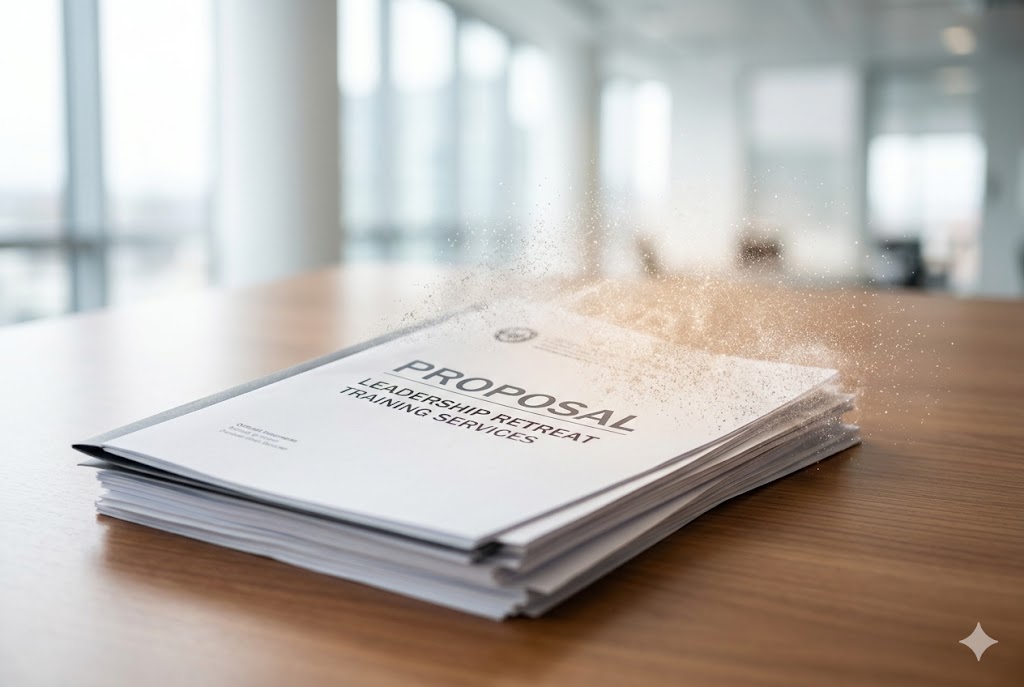
We Didn't Win. We Didn't Lose. Nobody Won.
We didn't win. It's not that we didn't win. It's just we didn't lose.
We placed a bid for a government contract. A leadership retreat. Which is our bread and butter. What we're great at.
And we received a notification that the results were posted.
So I went to check. And there were no results. Just a large list of people who submitted quotes.
In a certain way, it was great to see. Because we saw the full spectrum of different submissions. We're usually one of the highest bidders, and this time we were medium to medium-high. Some people quoted very little. And they were out of state. And I thought, how can you afford to do this kind of training for this little?
And some people were 50% more than what we quoted.
But that's not the point.
Nobody Won
The point is that when there was no visible information on who won, I emailed to ask. Since it wasn't the first time we'd submitted a bid for this county, we already had an established contact.
And I received an email back within an hour or two connecting me with the right person who was reviewing the bid.
And then that person's reply:
“Hi Irina, The QQ was marked as 'not awarded'. The department has requested to revise the scope of work and then reissue at a later date. Thanks for reaching out!”
They had changed their mind. Nobody won. There's no award status. Which in one way is a good thing. Because then we can apply again and hopefully get it next time.
But in another way, it sent me into a spiral about wasted resources.
The Government Side
On the government side, we're talking about hours of preparing the bid, putting it out, receiving all the answers, and analyzing them. And all of that is happening manually. It's a lot of labor hours. Payroll hours.
The Private Sector Side
And on the private sector side, as a company, we have a team. We spend hours researching, applying for, creating, and providing bid information.
So I asked Claude to do some research for me. I wanted to know what these wasted resources actually cost in payroll and money.
And of course, there is no official data. Because the government doesn't track that kind of information.
Go figure. Why would we track wasted resources? Why would we admit that we're doing something wasteful?
And for me, they're wasting our money. Taxpayer money.
What Nobody Tracks
The more I deal with government, the more inefficiencies surface. And it seems like nobody is questioning them.
And when you do question them, people who work for the government take it very personally.
They take pride in saying, "We are doing it by the rules we were given."
But nobody ever questions the rules.
How long have you been doing it? Following these rules? And if you've been doing it for decades in the system, and the rules haven't changed, and efficiency hasn't increased, maybe it's time to ask why.
The Cost Nobody Measures
Here's what I wanted to know: What does this actually cost?
So I tried to find data. Official government tracking of how often solicitations get canceled. How much money is wasted when they do.
And there is none. The government doesn't track this.
But I can estimate based on what we do know.
For our quick quote submission, we invested about 15 hours of work. Between researching the requirements, preparing the response, reviewing pricing, and finalizing the submission. At a conservative internal cost of $100 per hour (accounting for senior staff time, benefits, and overhead), that's $1,500 in labor cost for our company alone.
We weren't the only ones. There were at least 10 other bidders on that list. If each company invested similar time, that's $15,000 in private sector resources spent on a solicitation that resulted in no contract.
And on the government side? Conservatively, preparing the solicitation, posting it, receiving submissions, and reviewing them probably took 20-30 hours of staff time. At an average loaded cost of $40 per hour (government employees average $26-35/hour base salary, plus benefits brings it to roughly $40/hour), that's another $800 to $1,200 in taxpayer money.
So this one quick quote that got canceled cost roughly $16,000 to $17,000 in combined wasted resources. For nothing.
Now Multiply That
Now let me scale that across the system.
An estimated 500,000 to 700,000 solicitations are issued annually across federal, state, and local government. That number itself is an estimate because, again, nobody tracks this systematically.
Based on industry experience and conversations with other contractors, solicitation cancellations appear to happen in roughly 10 to 15 percent of cases. Let's use 10 percent as a conservative estimate.
Ten percent of 500,000 to 700,000 solicitations means 50,000 to 70,000 canceled bids every single year.
On the government side, the average cost per solicitation in staff time ranges from $1,600 for simple quotes to $17,000 or more for complex procurements. The average sits around $6,000 to $8,000. Let's use $7,000.
At $7,000 in government payroll per bid, multiplied by 50,000 to 70,000 canceled solicitations, that's $350 million to $490 million in wasted government labor per year. Salary dollars paid to produce nothing.
Now the private sector side. If we assume an average of 30 vendors per bid, with each spending about 40 hours on preparation, at an internal cost of $75 per hour, that's $90,000 in wasted private sector resources per canceled bid.
Multiply $90,000 by 50,000 to 70,000 canceled bids, and you get $4.5 billion to $6.3 billion in private sector time wasted annually.
Combined, we're looking at roughly $5 to 6 billion per year. For bids that produced zero value. No contracts awarded. No services delivered. No problems solved.
Just wasted time and wasted money.
And the honest truth is that these are working estimates. The 500,000 to 700,000 solicitations number is not officially tracked. The 10 percent cancellation rate is an assumption based on industry experience. The actual number could be higher.
And nobody in government is required to report it.
What This Actually Means
Every time a government agency posts a bid, dozens or even hundreds of companies invest time and money preparing their submissions.
Writers. Researchers. Subject matter experts. Project managers. Legal review. Financial analysis.
And when the agency changes its mind and cancels the solicitation, all of that work evaporates.
Not just for one company. For every company that submitted.
The Inefficiency Nobody Measures
And here's the thing: This isn't a rare occurrence.
From my experience and the research I could find, solicitation cancellations happen frequently. For all kinds of reasons. Changed requirements. Lack of funding. Decision to use a different contract vehicle. Budget cuts.
And every single time, the cost is borne by the private companies who prepared bids in good faith.
Why This Matters
This matters because we're not just talking about corporate waste. We're talking about small businesses. Veteran-owned businesses. Women-owned businesses. Companies that are trying to do good work and serve their communities.
And every dollar they spend on a canceled bid is a dollar they can't spend on employees. On training. On growth. On actually delivering the services they're good at.
And on the government side, every hour spent preparing a solicitation that gets canceled is an hour that could have been spent actually solving the problem they were trying to solve in the first place.
The Question Nobody Asks
The question nobody asks is: Could this have been avoided?
Could better preparation up front have prevented the need to cancel?
Could clearer requirements have made it obvious from the start that the solicitation wasn't viable?
Could more realistic budget planning have prevented the "lack of funding" cancellation?
I haven't dived deeper into what exactly is causing these cancellations. And that would be interesting research to do.
But overall, the more I deal with government, the more the inefficiencies come to the surface. And it seems like nobody is questioning them.
The Resistance to Questions
And when you do question, people take it personally.
They hear criticism. They hear judgment. They hear "you're doing it wrong."
But that's not what I'm saying.
I'm saying: There has to be a better way. There has to be a way to do this that doesn't waste thousands of hours and hundreds of thousands of dollars every single time someone changes their mind.
What Change Actually Looks Like
Change doesn't start with blame. It starts with curiosity.
What if we asked: Why did this solicitation get canceled? What could we have known earlier that would have prevented this?
What if we tracked: How much time and money is being spent on solicitations that never result in awards?
What if we measured: What is the actual cost of this process, and is there a way to reduce it without reducing quality?
These aren't revolutionary questions. They're basic efficiency questions. The kind that any business would ask.
But government doesn't operate like a business. And maybe that's the problem.
The System Protects Itself
The system is set up to protect itself. Not to optimize. Not to improve. But to follow the rules.
And the rules say: Agencies have broad discretion to cancel solicitations. For almost any reason. At almost any stage.
And the companies who spent time and money preparing bids? They have no recourse. No reimbursement. No acknowledgment that their resources were wasted.
Because the rules don't account for that.
What I've Learned
I've learned that if you've been doing something for decades and the efficiency hasn't increased, it's not because the system is working.
It's because nobody has the authority, or the incentive, or the willingness to change it.
And the people who could change it are the same people who have been operating within it for so long that they can't see it anymore.
They take pride in following the rules. And they should. Following the rules is important.
But someone also has to ask: Are these the right rules? Are we optimizing for the right outcomes? Are we serving the people we're supposed to serve?
The Bigger Picture
This isn't just about one canceled bid for one leadership retreat in one county.
This is about a system that wastes resources at scale and doesn't measure it. Doesn't track it. Doesn't even acknowledge it as a problem.
And as long as we don't measure it, we can't fix it.
As long as we don't question it, we can't improve it.
As long as we take questions as personal attacks instead of opportunities for growth, nothing will change.
What Needs to Change
What needs to change is the willingness to ask hard questions.
Not from a place of blame. From a place of genuine curiosity and a desire to do better.
Why do solicitations get canceled? What are the most common reasons? Could those reasons have been identified earlier in the process?
How much does it cost, in aggregate, when solicitations are canceled? Both on the government side and the private side?
What would it look like to reduce that cost? Not by restricting agencies' ability to make good decisions, but by improving the quality of decisions made upfront?
These are solvable problems. But only if we're willing to acknowledge that they exist.
The Invitation
So this is an invitation.
To the people who work in government procurement: You are not the problem. The system is the problem.
And you are the people who are closest to it. You see the inefficiencies. You experience the frustrations. You know where the process breaks down.
And you have the knowledge to fix it. If you're given the permission to question. To experiment. To try something different.
To the people who run companies that bid on government contracts: We need to start talking about this.
Not just complaining. Actually measuring. Actually documenting. Actually making the case that this is a problem worth solving.
Because as long as nobody tracks it, nobody will fix it.
The Reality
The reality is that we didn't win. We didn't lose. Nobody won.
And that's the problem.
Because in a functioning system, someone should win. The best provider should be selected. The work should get done.
But in a system where solicitations get canceled after all the work has been done, nobody wins.
The government doesn't get the service they need.
The companies don't get the contract they prepared for.
The taxpayers foot the bill for all the wasted hours.
And nothing changes.
What I'm Left With
I'm left with the question: How do we change a system that doesn't want to be questioned?
And I don't have the answer yet.
But I know it starts with asking. And being curious. And refusing to accept "this is the way we've always done it" as a good enough reason.
Because if we've always done it this way, and it's not working, then maybe it's time to do it differently.


