They Don’t Need to Toughen Up. They Need to Understand Themselves.
They Need to Understand Themselves.
If you’ve ever stood on a sideline, in a boardroom, at a kitchen table, or in the mirror and wondered why someone who cares so deeply suddenly shuts down, melts down, lashes out, goes silent, or feels “off”…
This is for you.
It’s about nervous systems.
It’s about belonging.
It’s about the invisible battle between who we think we’re supposed to be and who our bodies are actually trying to protect.
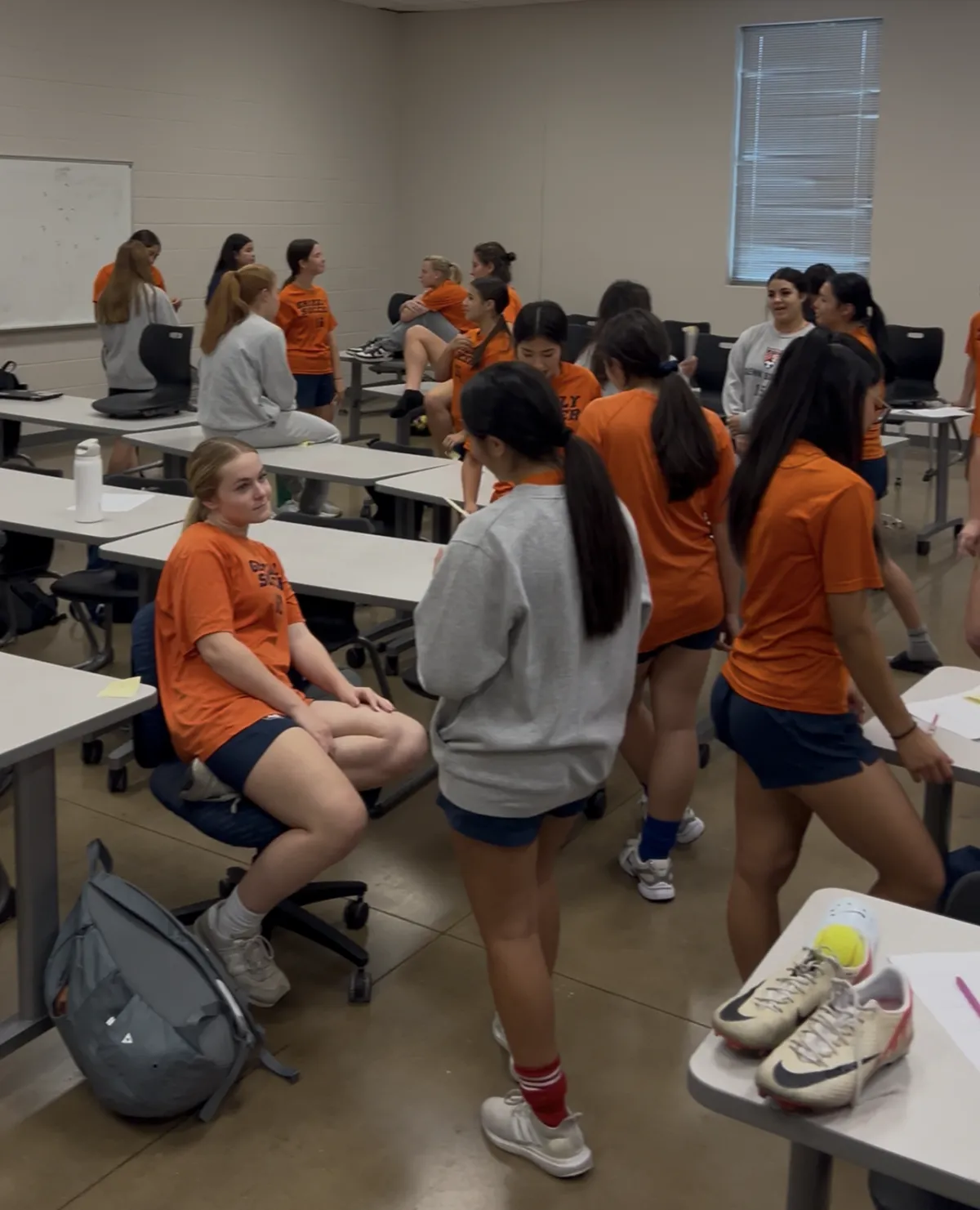
It just happens to take place with a group of high school girls in cleats.
“I’m Not Broken. I’m Human.”
There’s a quietness that settles in a room when a truth lands.
We were talking about how the brain and body loop together —
how a thought can ignite emotion,
how emotion becomes sensation,
how sensation turns into behavior,
and behavior writes the story of whether you feel like you belong in your own life.
And finally, someone said it:
“I never realized my brain wasn’t trying to ruin things.
It’s trying to protect me.”
Pause.
They had always felt the overwhelm.
They had just never understood it.
Once they did, you could feel the shift:
their shoulders softened,
their breathing slowed,
and for the first time… their nervous systems didn’t have to fight alone.
And isn’t that true for most of us?
We don’t need to be scolded for our reactions.
We need to be understood inside of them.
“I Thought I Was the Only One.”
Every sports documentary has the moment where the team realizes they’re not just players —
they’re humans hanging onto one another in a world that demands results.
For us, it came when girls began saying things like:
“I make my mistakes feel bigger than they are.”
“I’m really hard on myself.”
“I thought I was the only one dealing with this.”
That sentence is oxygen.
Because loneliness doesn’t always look like sitting alone in a cafeteria.
Sometimes it looks like laughing with your teammates while secretly believing you’re the only one who feels like they’re falling apart.
This wasn’t “group therapy.”
This was them learning how to become a team that can witness each other without fixing, rescuing, or pretending.
Belonging isn’t cute.
It’s stabilizing.
It quiets the storms.
And when you’ve spent enough of your life bracing, stabilizing feels like a miracle.
Drama Isn’t an Attitude Problem.
It’s a Nervous System Strategy.
Cue the slow-motion montage:
big emotions,
tight shoulders,
deep sighs,
and that very particular teenage silence that says,
“I care more than I know how to say.”
We talked about the Drama Triangle,
not to shame them with psychological jargon
but to give their reactions somewhere to belong.
Hero.
Villain.
Victim.
And you could see them recognize their roles:
The fixer.
The one who collapses inward.
The one who fires back when it hurts too much to stay soft.
But then something almost holy happens when you give people choice:
We talked about the Empowerment Triangle
Coach.
Creator.
Challenger.
And somewhere between “this is who I’ve been” and
“this is who I want to be when it gets hard,”
you could see them step toward themselves with more compassion.
That isn’t softness.
That’s maturity.
Learning How To Tell the Truth Without Burning the Relationship Down
Every sports doc has the “learning to communicate” montage too:
film rooms,
hard conversations,
quiet apologies on a bus.
For us, it sounded like:
“I feel…”
“When…”
“Because…”
“And what I need is…”
And no —
that isn’t weakness.
That’s nervous-system-safe honesty.
You could literally watch the room slow down.
Breathing steadied.
Clarity grew.
No one had to attack to be heard.
No one had to disappear to keep the peace.
One girl said:
“I feel like I can actually say what I need now
without people thinking I’m attacking them.”
Another:
“I don’t have to shut down or explode.
I can just tell the truth.”
Roll the inspirational soundtrack.
Because when teenage girls learn what many adults never do?
That’s leadership.
“If My Values Aren’t There… I Don’t Even Feel Like Myself.”
Here’s your slow zoom-in.
Values day.
Markers.
Paper.
Silence.
Values aren’t posters.
They’re oxygen tanks.
They are the things we instinctively protect because without them, being somewhere stops feeling like being home.
So when they shared?
It wasn’t childish.
It was painfully honest:
“If my values aren’t there, my game isn’t as good.”
“I’d feel more insecure… like I can’t open up.”
“I wouldn’t be able to connect.”
“Honestly? It wouldn’t even be worth much anymore.”
They weren’t talking about soccer.
They were talking about identity.
Because when your values aren’t honored,
your nervous system doesn’t file that under “mild inconvenience.”
It files it under:
I am not safe here.
And when they are honored?
People breathe.
People belong.
People come back to themselves.
And people perform from wholeness instead of fear.
And Here’s the Part Where the Story Turns Toward You
This isn’t really all about teenage girls.
This is about:
parents holding families together while exhausted,
coaches carrying cultures on their backs,
leaders who still think pressure builds diamonds,
employees quietly drowning while smiling,
and entire generations trying to be strong without breaking.
We don’t fall apart because we’re weak.
We fall apart because we’re unsupported.
Belonging isn’t optional.
Values aren’t fluff.
Communication isn’t decoration.
Performance without humanity always collapses.
They don’t need to toughen up.
They need:
language,
tools,
safety,
connection,
and grown-ups who understand that staying human
isn’t a liability in hard environments —
it’s the competitive advantage.
And honestly?
So do we.


