It Looks Easy. And That's Exactly the Point.
And That's Exactly the Point
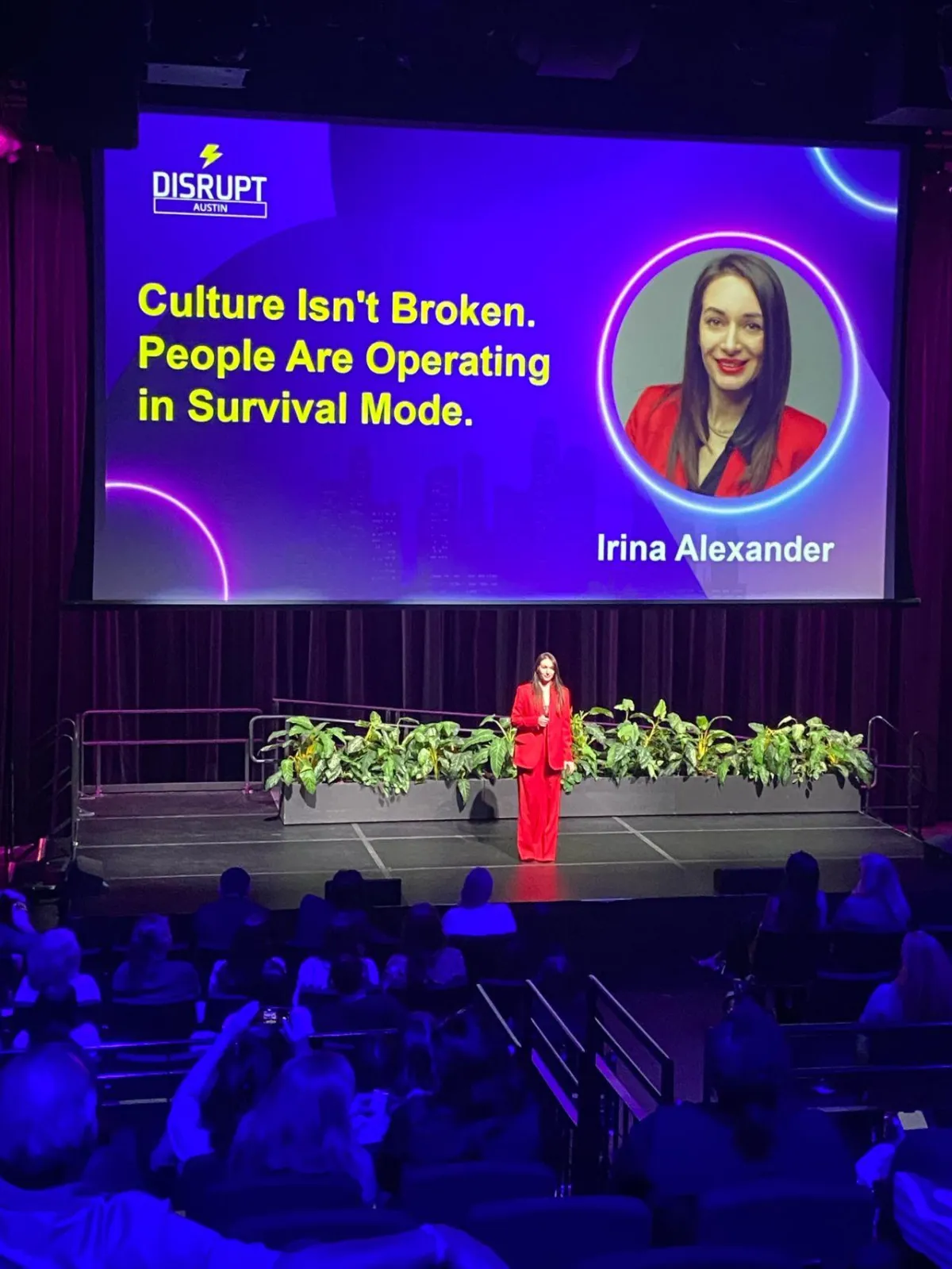
I walked off the stage still buzzing.
High energy. Room fully engaged. Fifteen seconds per slide, five minutes total. The kind of talk where you feel it working in real time, and you just stay in it.
Afterward, while everyone was still mingling, one of the other speakers found me. She'd had a harder time up there. A few stumbles. Some forgotten content. The kind of moments that feel enormous when you're standing under the lights, even when the audience barely notices.
She looked at me and said,
"Well. Not everybody is as natural as you."
Jen, my business partner, was standing right next to me. And before I could say a word, Jen said it perfectly.
"We are trained to do that. We were trained to speak on stages. And Irina has practiced a lot."
What People See and What They Don't
I've thought about that exchange a lot since walking off the stage.
Because here's the thing: she wasn't wrong. Some of what happens when I'm up there is genuinely natural to me. My energy. The way I move. The cadence of how I speak. Those things are just part of who I am.
But most of what looks easy? That took years.
I've been very public about the work I put into my craft. Not to perform humility. But because I think the "she's just naturally good at that" story does a quiet kind of damage to everyone who hears it.
When you watch someone perform at a high level and decide it's because they were born that way, you've closed the door on yourself before you even tried. You've made their result about their genes instead of their choices.
The truth is messier and more honest than that.
The week before that talk, I was deep in practice. Not reviewing. Practicing hard. Running slides, timing myself, adjusting, running it again. That format doesn't forgive you. Fifteen seconds per slide. The deck advances whether you're ready or not. You either know your material cold or you find out in front of a room that you don't.
I've done the work for years to make five minutes look like nothing. And when someone says, "It just looks so easy," I want to say thank you, because that is the entire point. That's what the work is supposed to produce.
For the Speakers Who Were Hard on Themselves
But the conversation that stayed with me most wasn't about me.
It was about the speakers who didn't land it the way they hoped.
I watched a few of them afterward. Quiet. A little withdrawn. Being polite to people, congratulating them, while somewhere behind their eyes, they were replaying every stumble.
I wanted to say something, so I did.
You were selected from more than a hundred applicants. Out of everyone who applied, they picked you. You wrote something. You rehearsed something. You stood up in front of a room full of people in one of the most demanding speaking formats there is, and you did it all the way through.
That format is hard. It's one of the hardest for a non-professional speaker. Fifteen seconds per slide, no stopping, no adjusting on the fly, no safety net. Most professional speakers avoid it. The people on that stage chose it.
That is not a small thing.
And yes. Be kind to yourself. The self-awareness that comes after a hard performance is useful. It's part of getting better.
But here's the part nobody wants to say out loud.
The audience didn't deserve a half-done job either.
The people who showed up, who paid to be there, who gave their evening, who sat in those chairs and paid attention, they deserved your best. Not your best attempt. Your best prepared, most practiced, most ready version of yourself.
We were lucky that night. The audience was gracious. They felt the effort even when the execution wasn't there. They were kind. But an audience doesn't owe you that kindness. And when we walk onto a stage underprepared, we're not just letting ourselves down. We're doing a disservice to the people who came to hear something that moves them.
So yes, give yourself grace. And also let that sit with you as motivation, not punishment. The audience deserves your preparation. And that's a reason to prepare, not a reason to spiral.
Both things are true at the same time.
What Natural Actually Means
I've been speaking professionally for years. I've trained specifically for this. I've failed on stages that nobody saw and learned things that never made it into any highlight reel.
The woman who said I was naturally gifted was looking at the outcome of all of that and seeing talent.
What she was actually seeing was a decision, made over and over again for years, to get better at something until it looked like I was born doing it.
That's available to anyone.
Not overnight. Not without the hard days. Not without the talks that didn't land, the practices that felt pointless, and the moments of wondering if it was worth the effort.
But available.
The stage doesn't lie. And it doesn't care about natural ability. It cares about preparation.
I walked off that stage buzzing because I prepared for it.
At The Academy of MotivAction®, we develop leaders who can communicate, perform, and lead under pressure. Whether you're preparing for a high-stakes presentation, a difficult conversation, or a room full of skeptics, we help you show up prepared.
Because confidence isn't a personality trait. It's a result of doing the work.
Learn more: https://motivaction.academy/


