When Everyone's a Coach But Nobody's Qualified
Have you ever watched someone confidently explain something they clearly don't understand?
I was scrolling Instagram in the morning.
A reel caught my attention. A woman breaking down a Tony Robbins and Alex Hormozi interview. Small following — just over 2,000. But the video had gone viral. Over 60,000 views when I watched it.
She's selling a course. Something called "Alter Ego" with AI-generated script that inerviews your future self and buids your alter ego. Good for her. I'm all for people building businesses.
Normally, when I see something I disagree with on social media - I scroll. Everyone's entitled to an opinion, even when it contradicts the facts.
But this one stopped me.
I actually commented.
Because she said she's a coach for Tony Robbins—which is possible, he has a large pool of coaches. And she gave her "professional opinion" about what was happening in the video.
She was completely wrong.
What She Called It vs. What It Actually Was
She said Tony was doing an "intervention" with Alex.
He wasn't.
He was doing a simple NLP technique called: parts integration.
Tony even says it in the interview: "Looks like you have a part of you... and another part."
That's basic NLP. It's taught in the first level of practitioner certification. We teach it in our Life By Choice program with NLP Practicioner Certification at MotivAction®.
It's not an intervention. It's acknowledgment and integration of internal parts. Fundamental technique.
And she confidently labeled it wrong — to 60,000 people. Then linked it to her product. Good for her... not so good for coaching industry.
Why This Made My Chest Tight
I'm sitting there, staring at my phone. My jaw clenched. That familiar tension.
Part of me wanted to scroll. "It's just social media. Let it go."
But I couldn't.
Because the coaching industry is close to my heart. And it's so unregulated that anyone can claim to be a professional — whether they are or not.
So I commented:
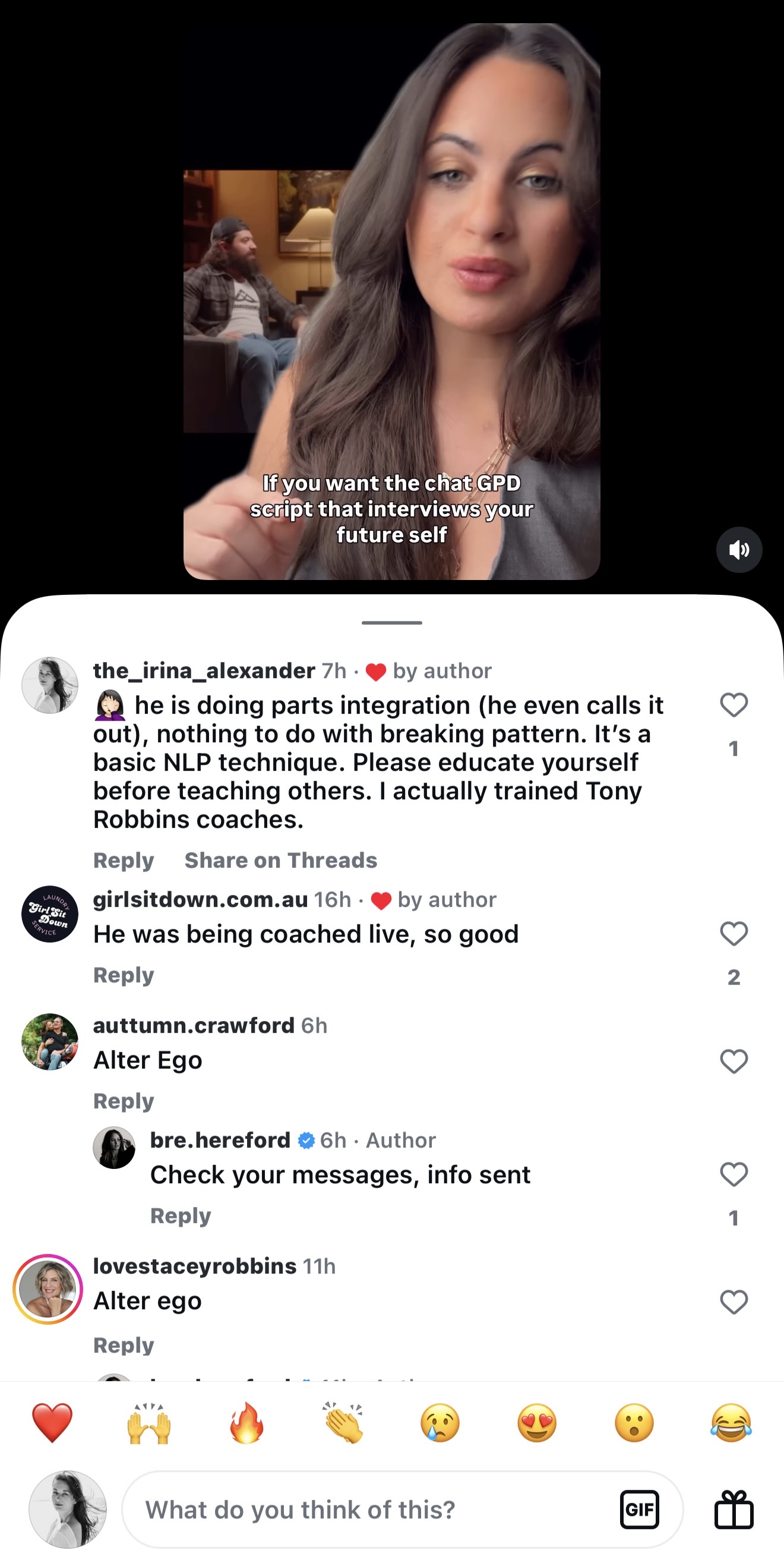
And then I sat with the question: Am I being controlling? Or is this about quality?
Here's What Most People Don't See
There are 8 billion people on this planet. Plenty of business for everyone.
But we need quality.
Because tools are powerful. And in the wrong hands, or untrained hands, they can harm people.
Right now, we're training our first instructor to teach the CARES™ content at MotivAction®. We're an educational company. A training academy. This matters to us.
And we're looking at six months of regular training before we can let this person teach independently.
6 months!
Not a weekend workshop. Not a certification you buy online. Not AI-generated questions and a course you sell after going viral once.
Six months of working with them on how it's taught, what is said, what qualities they need to possess to do this work responsibly.
That's the standard.
And If We're Honest
The coaching industry has a problem.
Someone takes a week-long training and calls themselves a coach.
They learn a few techniques. Get a certificate. Hang a shingle.
And suddenly they're "helping people transform their lives."
But here's the nuance: learning tools ≠ being qualified to coach.
When we certify people at MotivAction®, we don't give a coaching certification.
We give a practitioner certification.
What does that mean?
It means you can practice the tools we taught you. You understand the techniques. You know the frameworks.
But to actually coach someone? That's a whole different level.
That requires skills and abilities that don't come from a classroom. They come from day-to-day application. Real conversations. Failures. Repairs. Years of practice.
The Quality Control Nobody Talks About
In order to be certified as a coach—not just a practitioner—there must be quality control.
I cannot call someone a coach just because they finished a course.
Why?
Because the services they provide can harm people if they're not ready.
These tools are powerful. They access deep parts of people's psychology, trauma, identity. And if you don't know what you're doing—if you haven't developed the discernment, the presence, the regulation to hold space properly — you can cause damage.
Not because you're malicious.
Because you're undertrained.
What She Could Have Said Instead
If this woman had said: "Hey, I noticed parts work happening here. I have a tool to help you identify your internal conflicts and integrate them to become a more whole version of yourself" —
I would have scrolled right past.
That's accurate. That's helpful. That's ethical.
But calling it an "intervention"? Selling a course based on misidentifying a basic technique?
That's misleading.
And it matters.
The AI Question
She's using AI-generated questions in her course.
And look — AI can absolutely help. It can ask good questions. It can provide structure.
But there's a quality that good coaches possess that AI cannot replicate.
Presence.
Attunement.
The ability to feel when something shifts in the room.
The wisdom to know when to push and when to hold space.
The regulation to stay grounded when someone's system is dysregulated.
That's not programmable.
That's developed through years of doing the work — on yourself first, then with others.
Check Your Own Standards
So here's the uncomfortable mirror:
Have you ever claimed expertise you didn't fully have?
Have you ever sold something before you were truly ready to deliver it well?
Have you ever used a credential or association to imply a level of training you haven't actually completed?
I'm not asking to shame you.
I'm asking because this is how the industry dilutes itself.
One person at a time. One viral reel at a time. One misleading claim at a time.
And eventually, people stop trusting coaches altogether.
Because they hired someone who had a certificate but not the competence.
What Happens If We Don't Raise Standards
Because here's what happens when we don't demand quality:
People get hurt.
Not dramatically. Quietly.
Someone hires a "certified coach" who learned a weekend's worth of techniques and thinks they can handle trauma. They ask the wrong question. They push too hard. They don't know how to repair when things go sideways.
And the client walks away more fractured than when they started.
The client doesn't blame the underqualified coach.
They blame coaching.
"I tried therapy. I tried coaching. Nothing works."
But the problem wasn't the modality.
It was the practitioner.
And slowly, quietly, the industry loses credibility.
Not because coaching doesn't work.
Because we let unqualified people call themselves coaches.
For the New Coach Reading This
Maybe you just got certified.
Maybe you're excited. Ready to help people. Building your business.
Good.
We need more people committed to this work.
But please — don't claim expertise you don't have yet.
Don't call yourself a Tony Robbins coach if you attended one seminar.
Don't say you're doing "interventions" when you learned a basic technique last month.
Don't sell a course on something you can't accurately identify.
Be honest about where you are in your development.
Say: "I'm a newly certified practitioner. I've completed X training. I'm building my practice. Here's what I can help with."
That's not weakness.
That's integrity.
And integrity builds trust faster than inflated credentials ever will.
What We're Building Instead
At MotivAction®, we're committed to quality over volume.
We don't rush certifications.
We don't hand out coaching credentials after a weekend intensive.
We train practitioners. We develop their skills. We quality-check their work.
And now when they've demonstrated competence, presence, and ethical practice do we say: "Yes. You're ready to coach."
Because we're protective of the industry.
Not to gatekeep.
To safeguard.
There's a difference.
The Real Question
Is it controlling to demand standards?
Or is it responsible?
Is it gatekeeping to say "not everyone who takes a course is ready to coach"?
Or is it protection — for clients, for the industry, for the integrity of the work itself?
I think about that woman with 60,000 views.
I hope her course helps people.
I hope she continues learning.
I hope she takes the feedback and gets clearer on what she actually knows vs. what she thinks she knows.
Because if she does—if she commits to mastering this work instead of just selling it — she could be great.
But right now?
She's part of the problem.
And so is everyone who lets it slide.
If you're a coach, a practitioner, or someone considering this work — standards matter.
At MotivAction®, we don't just teach techniques. We develop competence. We train practitioners who become coaches through demonstrated skill, not purchased certificates.
If you're ready to do this work with integrity, we're here.
Learn more at MotivAction.academy.


